GRADUATE LEARNING OUTCOMES and CURRICULUM STRUCTURE
Graduate Learning Outcomes
All graduates of academic, vocational, and professional education must demonstrate the following attitudes (Decree of the Minister of National Education No. 49 of 201):
- Devotion to God Almighty and the ability to manifest religious attitudes;
- Commitment to humanitarian values when performing duties based on religious, moral, and ethical integrity;
- Dedication to enhancing quality of life for society, the nation, and the state, as well ascivilisation based on Pancasila;
- Patriotic citizenship in demonstrating nationalism and responsibility towards the nation and the state;
- Respect for diversity in culture, perspectives, religions, beliefs, and others’ original findings;
- Collaborative in spirit while possessing social awareness and environmental concern;
- Law-abiding conduct and discipline in societal and national settings;
- Internalise academic values, norms, and ethics;
- Professional responsibility and an independent work ethic in their field of expertise; and
- Self-reliant, persevering, and possessing an entrepreneurial spirit.
All graduates of academic, vocational, and professional education must demonstrate the following abilities:
- To apply logical, critical, systematic, and innovative thinking in developing or implementing science and technology while observing and applying humanities values that are relevant to their field of expertise;
- To demonstrate independent, high-quality, and measurable performance;
- To evaluate the implications of developing or implementing science and technology while upholding humanities values, scientific principles, procedures, and ethics to produce solutions, ideas, designs, or critical analyses of works of art;
- To develop scholarly descriptions of research findings in the form of a thesis or final project report and upload these to the university’s website;
- To make informed decisions when solving problems within their field of expertise, based on thorough information and data analysis.
- To establish and maintain professional networks with supervisors, colleagues, and peers, both within and outside their institution;
- To take responsibility for group work outcomes, as well as supervise and evaluate tasks assigned to team members under their oversight;
- To conduct self-evaluation processes for their work groups and manage independent learning effectively; and
- To document, store, secure, and retrieve data appropriately to ensure validity and prevent plagiarism.
Mastery of Knowledge for Bachelor’s Graduates in Sociology, FISIPOL UGM
- Mastery of the foundational principles of social sciences
- Command of core sociological principles
- Proficiency in sociological theories, social theories, and research methodologies for analysing social issues within contemporary contexts
- Application of sociological and interdisciplinary theories to address humanitarian and societal challenges at local, national, and global levels
Thorough understanding of academic principles and ethical standards
Specialised Skills of Bachelor’s Graduates in Sociology, FISIPOL UGM
- Capacity to analyse and respond to social change through sociological and interdisciplinary lenses;
- Competence in applying both qualitative and quantitative social research methods to datasets, including digital data sources;
- Ability to produce scholarly works in written formats and/or creative products;
- Professional readiness as social analysts, researchers, consultants, educators, community development practitioners, and social planners; and
- Empathetic communication, networking, and collaborative problem-solving in addressing humanity and life issues, grounded in empathetic and emancipatory values
Curriculum Structure
Based on Output-based Education (OBE) and Merdeka Belajar-Kampus Merdeka (MBKM)
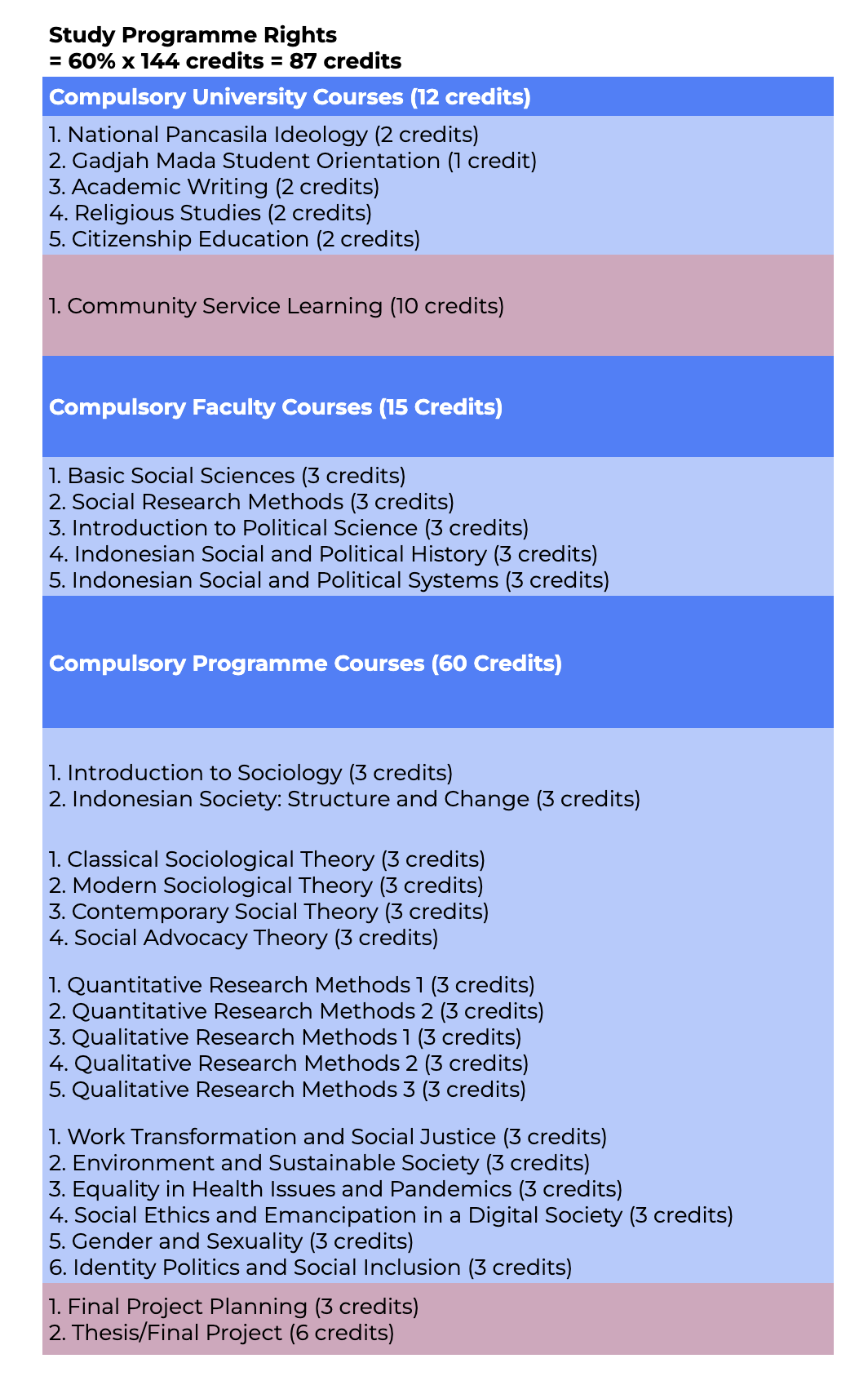
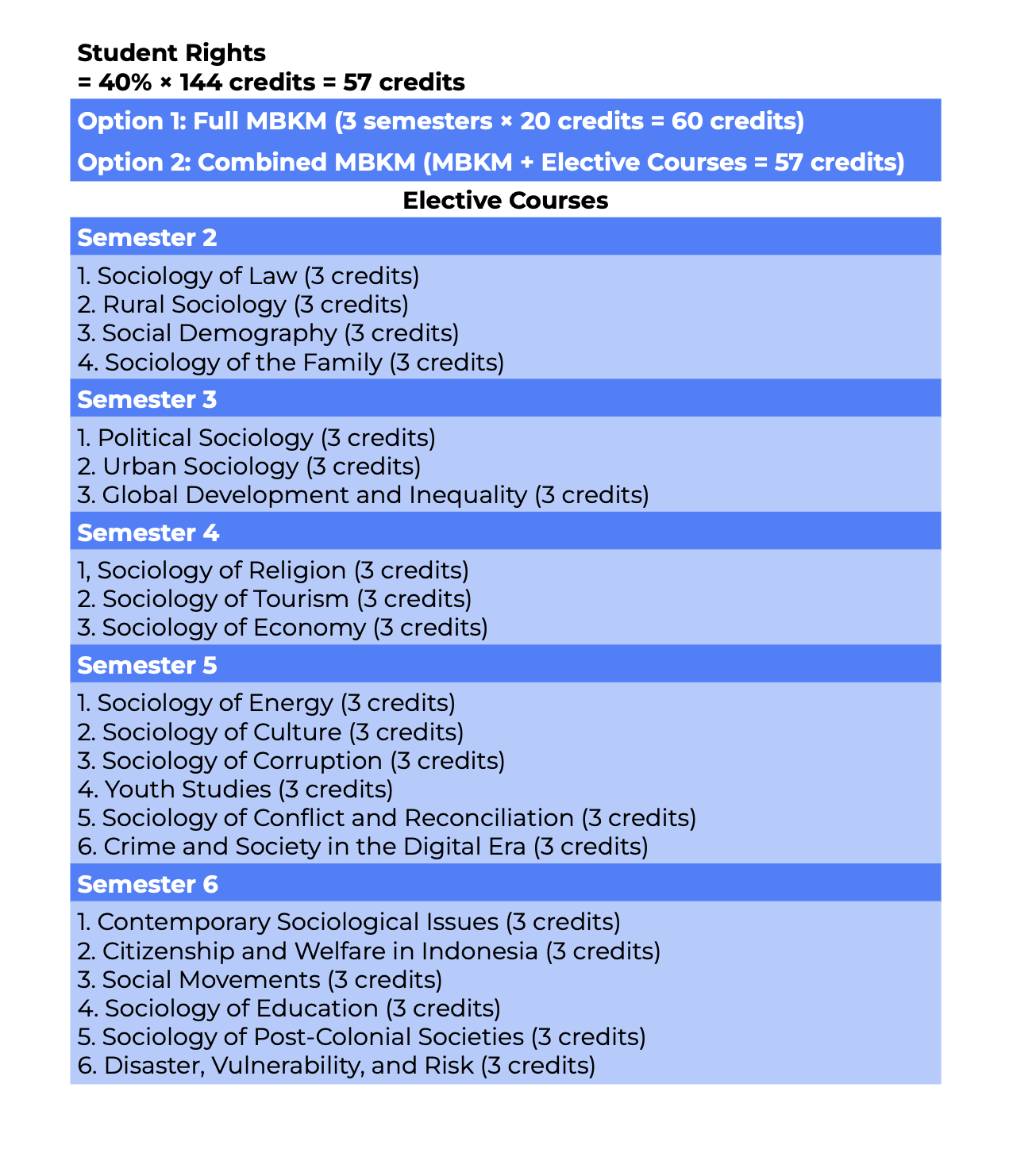
Graduation Requirements:
- Total credits: 149 (minimum)
- Minimum GPA: 2.0
- D grades: maximum 25%
- E grades: none permitted
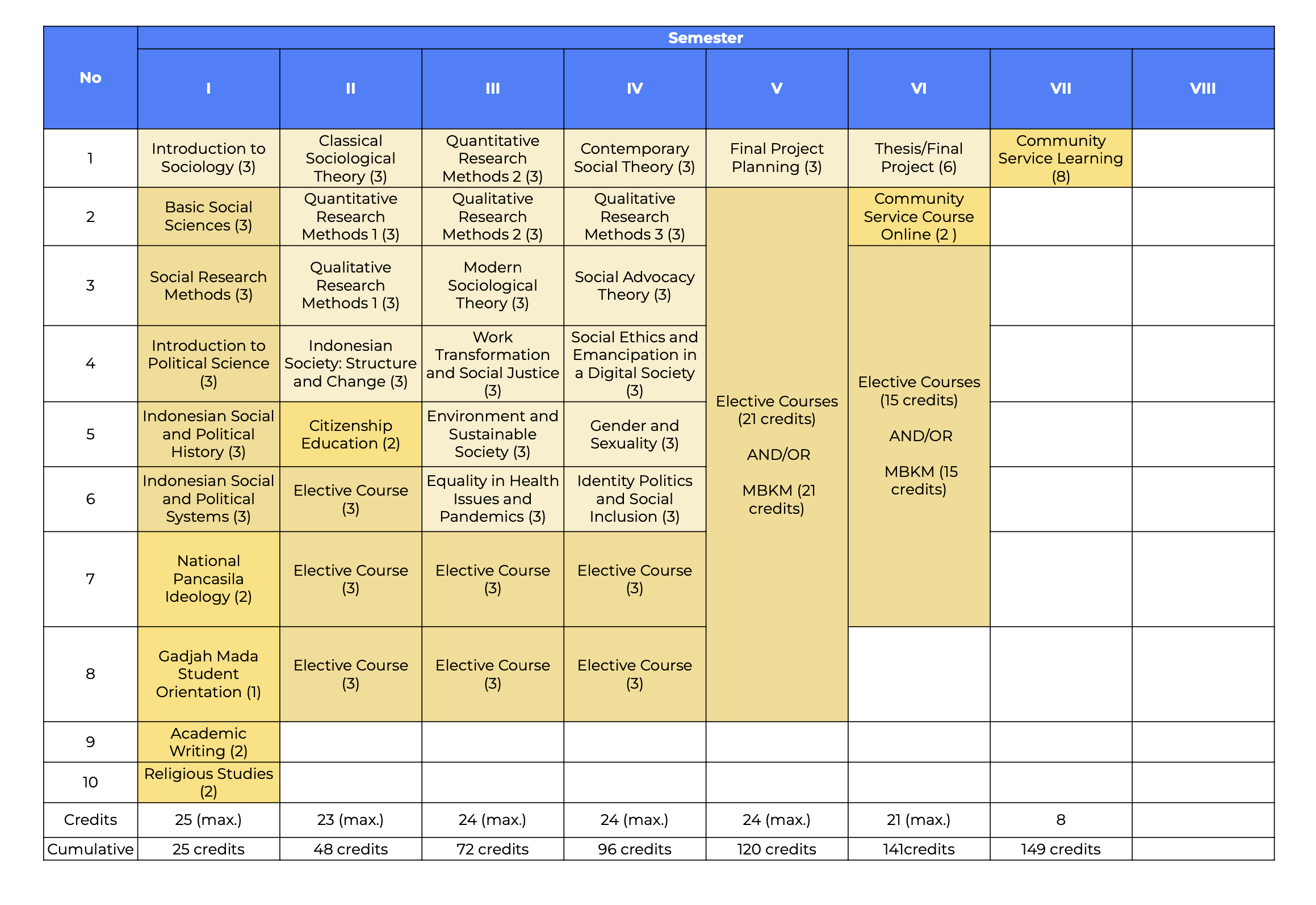
Course Matrix for Each Semester Based on OBE and MBKMBachelor’s Programme in Sociology, FISIPOL UGM as of July 2021
PARTIAL MBKM
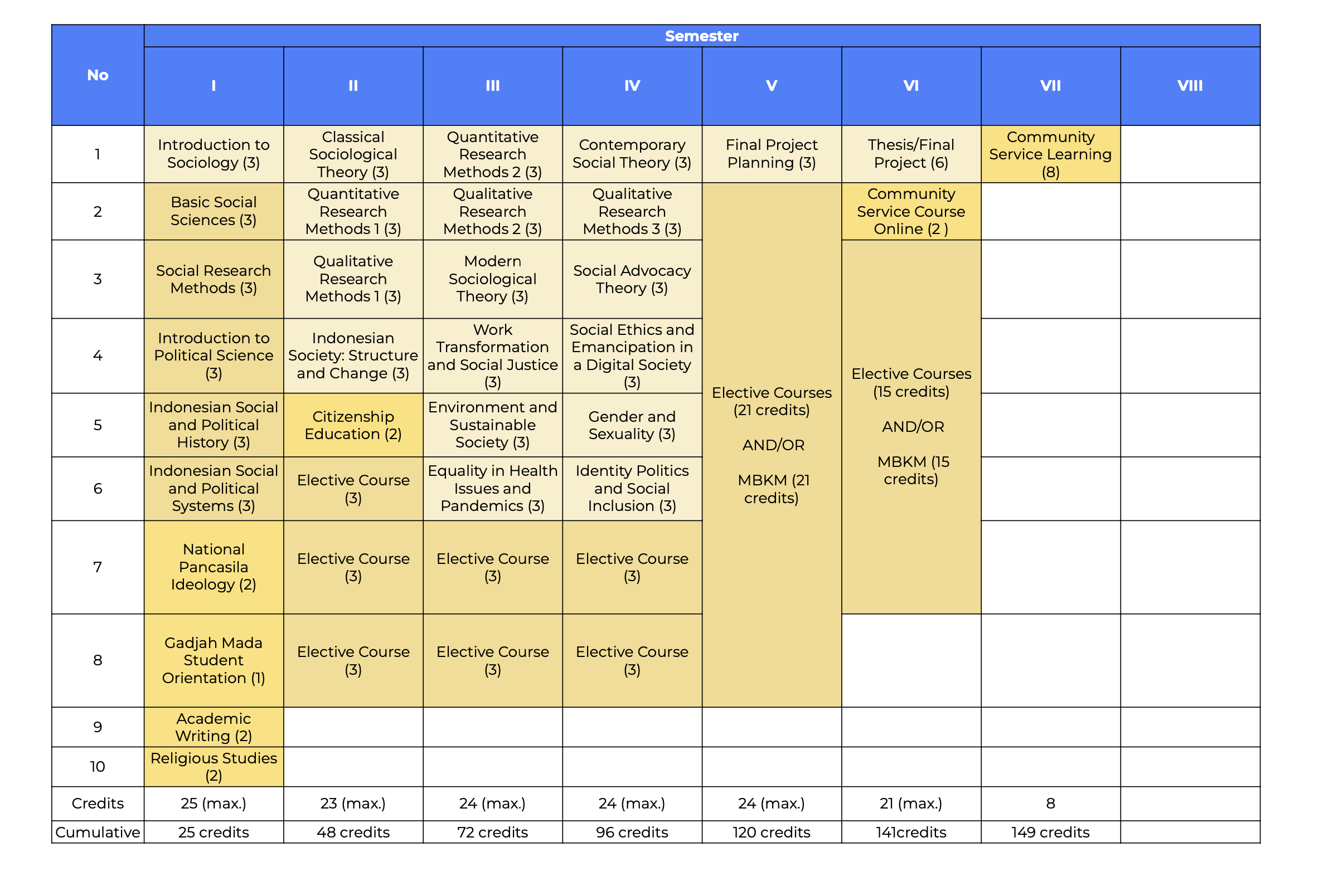
Course Matrix for Each Semester Based on OBE and MBKM
Bachelor’s Programme in Sociology, FISIPOL UGM as of July 2021
FULL MBKM